Start Here
How to Read Tarot Cards: A Grounded Beginner Guide
A practical first framework for reading tarot without pretending that a deck can make decisions for you.
Learning how to read tarot cards does not require a dramatic ritual, a perfect memory, or a claim to special authority. At its most useful, tarot is a structured way to pause with a question. The images, symbols, and positions give you language for a situation that may feel tangled or hard to name. You still decide what matters, what fits, and what you do next. This guide offers a beginner-friendly process you can repeat with a physical deck or a digital draw.
Start with a useful expectation
Tarot is often presented as a way to predict a fixed future. That framing can make a first reading feel high stakes and can quietly hand your judgment to a card. A more practical approach treats tarot as reflection. A card can spotlight a pattern, a fear, a resource, or a question you have not yet asked. It cannot replace medical, legal, financial, or safety advice, and it cannot prove what another person will do. The value of a reading is in the attention and conversation it creates.
A good beginner reading aims to do three things
- Give one real situation enough focus that you can describe it in a sentence.
- Offer images and themes that help you notice your own assumptions, needs, and options.
- End with a small action, question, or observation you can carry into ordinary life.
Know the basic shape of a tarot deck
Most modern tarot decks contain 78 cards. The 22 Major Arcana cards, such as The Fool, The Lovers, and The Hermit, are often read as broad human themes or turning points. The 56 Minor Arcana cards are divided into Wands, Cups, Swords, and Pentacles. They bring the reading closer to everyday energy, feelings, thoughts, conflict, work, resources, and relationships. Each suit includes numbered cards and four court cards: Page, Knight, Queen, and King.
| Part of the deck | What it can help you explore | Beginner prompt |
|---|---|---|
| Major Arcana | Big themes, transitions, values, and recurring lessons | What larger pattern is asking for attention? |
| Wands | Energy, creativity, motivation, and initiative | Where is my energy going? |
| Cups | Feelings, connection, imagination, and receptivity | What feeling needs an honest name? |
| Swords | Thoughts, communication, choices, and tension | What story am I telling myself? |
| Pentacles | Work, body, home, money, skills, and practical care | What needs steady support? |
You do not need to memorize all 78 meanings before you begin. Start by looking at the title, the scene, the colors, the direction of movement, and the emotion the image creates. Then compare your first observation with a trusted reference. Over time, you will learn both shared traditions and the way particular images speak to you.
Ask a question with room for reflection
A tarot question works best when it names a situation you can influence. It is usually more helpful to ask about your choices, needs, boundaries, or next conversation than to ask for certainty about someone else. A narrow timeframe can also make a reading easier to revisit. Instead of asking whether a relationship will last forever, you might ask what you need to understand about the relationship this month.
| Less useful framing | More reflective framing |
|---|---|
| Will they text me? | What would support honest communication in this connection? |
| Will I get the job? | How can I prepare for this application and evaluate the opportunity clearly? |
| Should I make a huge decision today? | What information, support, or timing should I consider before deciding? |
| Is everything going to be okay? | What is within my control while I move through this uncertainty? |
Use a repeatable first-reading process
A five-step tarot practice
- 01
Set a short container
Give yourself ten quiet minutes. Put your phone aside, take a breath, and write the question where you can see it. You do not need to force a special mood; simple attention is enough.
- 02
Choose a spread that matches your experience
For your first reading, choose one card. When you want movement or context, use three cards for past, present, and possible direction. Avoid a large spread until the smaller format feels familiar.
- 03
Describe before you interpret
Look at each card for a full minute. Name what is visible: figures, posture, weather, objects, colors, distance, and motion. Notice your immediate response without judging it as right or wrong.
- 04
Connect image, position, and question
Ask how the card image changes when it sits in this position. A sword in a present position may invite you to notice a conversation; the same card in a possible direction may point to a choice that needs clearer language.
- 05
Write one grounded takeaway
Finish with one sentence beginning with “I can.” Examples include “I can ask for more information,” “I can make space for disappointment,” or “I can delay a decision until I have slept on it.”
Some readers include upright and reversed cards. An upright card is simply one that appears right-side up; a reversed card appears upside down. There is no universal rule for reversals. You can read them as an inward expression, a blocked expression, a contrast, or skip reversals entirely while you learn. Consistency matters more than complexity. Record what method you used so you can see how it works for you over time.
Practice with one card before learning more spreads
Worked example
A one-card reading example
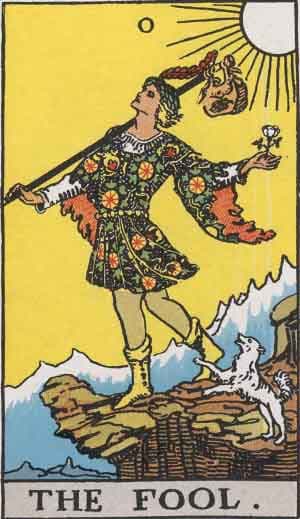
You are unsure whether to volunteer for a new project at work. You draw The Fool upright in a one-card reading.
“What would help me approach this opportunity with clarity?”
- 1
Notice the image
The Fool is often pictured at the edge of a path, carrying little and looking outward. You may notice openness, risk, movement, or inexperience.
- 2
Place it beside the question
The card does not guarantee that the project will succeed. It can invite you to consider whether curiosity is present and what preparation would let you take a sensible first step.
- 3
Choose a real response
You might ask for the project brief, identify the skill you want to learn, and name one boundary around your existing workload before agreeing.
Takeaway: The reading becomes useful when the image helps you form a better question and a practical next move, not when it promises an outcome.
Read relationships between cards, not isolated verdicts
In a three-card reading, meanings become more interesting when cards respond to each other. Look for repeated suits, numbers, directions of gaze, or contrasts. Three Cups may make emotional connection feel central. Several Swords may suggest that thought, language, or tension deserves attention. A Major Arcana card beside practical Pentacles can connect a large personal theme with a concrete responsibility. These observations are hypotheses to test against your life, not facts the cards prove.
Questions to ask after a three-card draw
- What changes from the first position to the last?
- Which card feels easiest to recognize, and which one do I resist?
- Do the images show movement toward, away from, or around something?
- What practical detail is missing from my understanding of this situation?
- What would I say if a friend showed me this same spread?
Keep a tarot journal that you will actually revisit
A journal turns tarot from a collection of memorable moments into a practice of observation. You do not need a beautiful notebook. A note with the date, question, spread, cards, first impressions, and one follow-up is enough. Revisit entries after a week or month. You may find that a card meant something different after a conversation, a decision, or a change in mood. That is useful information about your own process.
A simple journal template
- Date and situation: What is happening in plain language?
- Question: What am I trying to understand or choose?
- Cards and positions: What did I draw, including orientation if you use it?
- First response: What detail in the images stands out?
- Grounded next step: What can I do, ask, notice, or postpone?
- Follow-up: What changed when I looked back?
Tarot becomes easier to read when you stop trying to produce a perfect answer. Read slowly, make your thinking visible, and keep the outcome open enough for reality to teach you something. A deck is a companion to reflection, not an authority above your own judgment.
Sources and method
References used for the factual backbone.
TaroMind separates historical and structural facts from reflective interpretation. Sources support deck history and organization; practical prompts remain educational suggestions.
- The Pictorial Key to the Tarot
Internet Sacred Text Archive
A public-domain historical reference for the Rider-Waite-Smith tradition and its card titles.
- Tarot
Encyclopaedia Britannica
Background on tarot cards, their historical development, and the standard deck structure.
Put the guide into practice
Start a one-card practice
Draw one card privately and use the guide as a prompt for reflection.
Start a one-card practiceContinue exploring