Major Arcana 13
Death tarot card meaning
Death represents endings, transformation, transition, and release. This guide explains upright and reversed meanings, yes/no use, love and career context, Rider-Waite symbols, and documented public references without treating the card as literal doom.
Reading use
Meaning before interpretation
Public facts
History, order, iconography
Next step
Apply the card in a live reading
Quick meaning
Death tarot card meaning at a glance.
Start here for the core meaning, upright and reversed signals, love and career context, and the yes/no answer before the deeper card notes.
Core meaning
Death meaning
Death represents endings, transformation, transition, and release. This guide explains upright and reversed meanings, yes/no use, love and career context, Rider-Waite symbols, and documented public references without treating the card as literal doom.
Upright
Death upright
Upright Death marks a real ending or transformation. It asks what has already completed its purpose and what can only begin after the old form is released.
Reversed
Death reversed
Reversed Death often shows resistance to change, delayed closure, fear of transition, or a half-finished ending. The card asks what you are still trying to keep alive past its time.
Love
Death in love
In love readings, Death can indicate closure, deep transformation, or the end of a repeated relationship pattern. It is less about punishment and more about what cannot stay the same.
Career
Death in career
In career questions, Death can point to a role, identity, habit, or project that must end so a cleaner path can emerge. It favors honest transition over slow decay.
Yes/No
Is Death yes or no?
Death upright leans no; reversed it leans maybe. Death leans a no because it points to ending, release, transformation, and the need to let an old form close.
Historical context
Documented deck history around this card
Death belongs to the Major Arcana sequence that later occult publishers built on top of earlier European tarot card traditions. Public encyclopedia and museum references place tarot's roots in fifteenth-century card culture, while the Rider-Waite-Smith deck published in 1909 presents this card inside the now-familiar modern English-language sequence.
These fact notes stay deliberately narrow: deck history, published card order, and visual elements described in public source material. They do not expose TaroMind's private interpretation system.
Rider-Waite iconography
Visual elements worth noticing in the published card image.
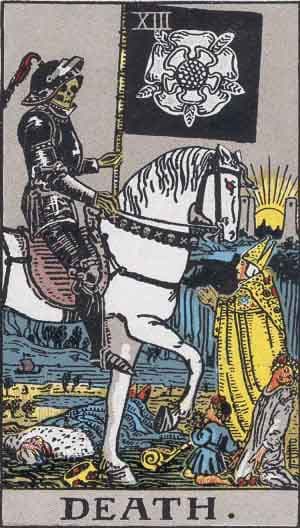
Visual note
Skeleton rider
Death appears as a skeletal rider in armor on a white horse.
Visual note
White-rose banner
The rider carries a dark banner marked by a white rose.
Visual note
Fallen figures and sun
Figures fall before the rider while a rising sun appears in the distance.
Yes or no tarot
Is Death a yes or no card?
Death leans a no because it points to ending, release, transformation, and the need to let an old form close. The reversed position changes the signal because the card's useful energy is blocked, delayed, or asking for repair before action.
Upright answer
No
Upright, Death signals ending, release, transformation, and the need to let an old form close. In yes/no work, that usually reads as a no when the question is clear and the querent is ready to act with context rather than chase certainty.
Reversed answer
Maybe
Reversed, Death shows resistance to change, unfinished grief, or trying to preserve a form that has expired. That changes the answer toward a maybe because the card's useful energy is blocked, delayed, distorted, or asking for repair before action.
Related cards
Read this card beside its closest neighbors.
Major Arcana 20
Judgement
Judgement represents rebirth, reflection, and the moment of reckoning and awakening.
Major Arcana 16
The Tower
The Tower represents sudden upheaval, revelation, and the breaking down of false structures.
Major Arcana 14
Temperance
Temperance represents balance, moderation, and the harmonious blending of opposites.
Reading contexts
Upright, reversed, love, and career notes for Death.
Upright meaning
Death upright
Upright Death marks a real ending or transformation. It asks what has already completed its purpose and what can only begin after the old form is released.
Reversed meaning
Death reversed
Reversed Death often shows resistance to change, delayed closure, fear of transition, or a half-finished ending. The card asks what you are still trying to keep alive past its time.
Love reading
Death in love
In love readings, Death can indicate closure, deep transformation, or the end of a repeated relationship pattern. It is less about punishment and more about what cannot stay the same.
Career reading
Death in career
In career questions, Death can point to a role, identity, habit, or project that must end so a cleaner path can emerge. It favors honest transition over slow decay.
FAQ
Common questions about Death.
What does Death mean in tarot?
Death means ending, transformation, transition, release, and the clearing away of an old phase. In tarot, it usually describes symbolic change rather than physical death.
Is Death a yes or no tarot card?
Death often leans no when the question asks whether things should remain the same. It can become a yes when the question is about ending, releasing, transforming, or accepting necessary change.
What are the main Death card symbols?
The armored rider, flag, fallen figure, river, sun, and distant towers point to unavoidable transition, surrender, and renewal beyond an ending. The page links public references behind these visual facts.
Source references
Public references behind the factual notes on this page.
Editorial note
This page keeps public history and visible card features separate from TaroMind's product-specific interpretation layer. When you want the card applied to your own situation, the live reading flow is where that reflective step begins.
Apply it live
Read the documented card, then ask what it means for you now.
Use this page as the public archive for meaning, sequence, and visible symbolism. Use the reading ritual when you want that symbol shaped around a real question, tension, or decision.